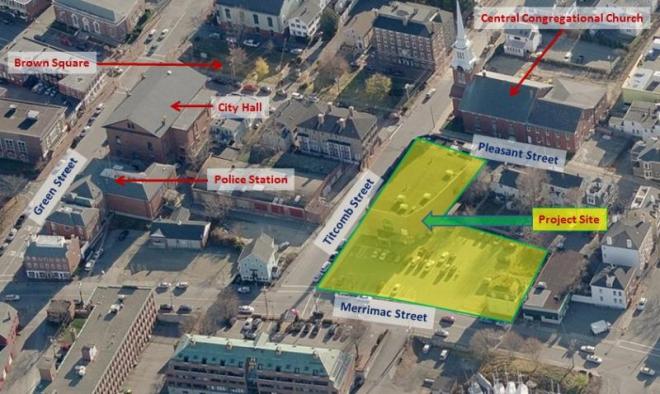
Is a $16 million parking garage at the corner of Merrimac and Titcomb streets the right move for Newburyport?
If there is $16 million, or even $9 million, to spend on parking, could it be better spent elsewhere to address the shortage?
Are we so focused on the state and federal funds that will help pay for a new garage that we can’t see the forest for the brick and trees?
These questions are not meant to undermine the hard work and efforts of all officials who have been working on the garage project for years. There is a long history of parking in Newburyport—as there is with every issue. There are some people who have already answered these questions to their own satisfaction and believe raising doubts now is akin to beating a dead horse.
I sense there are also many people who are uncertain.
Upfront, let me stress that questioning this garage plan at this stage is not the same as opposing this or any garage, or opposing more parking, or opposing finding a solution sooner rather than later. The point is to make sure the city has properly vetted its options before doing something that is irreversible in its effects. Are we comfortable with this plan? It could very well be that the Titcomb garage is the best answer at this time for the city. But let’s debate it. In short, I may be naïve, uninformed and unwise, but my motives are pure. I hate it when debates turn into excuses to demonize and divide.
It’s important to remember that the parking garage is very much still in the planning stage; it’s not yet a done deal. As the city delves deeper, it may decide to try something else.
A vibrant downtown is critical to our community and a vibrant downtown depends on making it easy for customers, employees and visitors to park. Some residents living near downtown also depend upon public parking. There is no question that the city should do something about parking.
California Dreaming
When I first heard that the garage would cost $16 million, I thought that seemed high. I happened to have come across a public building plan in Del Mar, California, a beautiful, wealthy, coastal city near San Diego (where my boss lives) that was to cost about $18 million. This plan included a civic center, with a 3,200-square-foot town hall, a 9,250-square-foot city hall for administrative services, a 15,000-square-foot outdoor public plaza for community activities, and 160 spaces for parking in both a two-level underground parking garage and a surface parking lot.
Now I might be comparing apples to avocadoes but it got me thinking about spending $16 million for just a garage.
Reportedly the city itself will only have to fund $9 million of the $16 million for the Titcomb structure since the state is willing to kick in $5 million and the federal government, $2 million. It still seems the overall building cost is high. And, of course, that is the price today.
outer space
The most recent garage design is projected to allow for 345 parking spaces. That’s more than $46,000 per space. I am no expert in the economics of garages. There are many variables, including labor costs, the space and height available for building, architectural considerations especially in an historic and coastal city, and the price of acquiring land. But $46,000 per space seems rather pricey to me. My eight-year-old CRV might be uncomfortable in such a luxury space. To be fair, the city’s cost would be more like $26,000 per space after federal and state contributions but even that seems high.
[Editor’s Note: The following has been updated from earlier version with better information on costs.]
But as I said, I am no garage construction expert. Garages are apparently expensive to build. A 2002 study came in with a cost per space of $37,000 while a 2005 study by Dore & Whittier for another 350-space garage on Titcomb went as high as $49,900 per space. Construction costs have obviously risen a lot since then!
So if $46,000 per space is what it costs in today’s dollars, that’s what it costs. It still begs the question if that is money well spent.
Of bigger concern is that it’s not clear how many new parking spaces would be created in the end—- after removing 150 from the waterfront and, as has been reported by the Daily News, giving New England Development another 90 as part of the deal.
What will be the net gain? About 105 spaces? That’s about $152,000 per new space overall, or $86,000 to the city after state and federal funds.
(Oh, and amongst yourselves, please debate whether the city should subsidize the parking needs of its biggest landowner-— or if NED should instead be helping the city.)
SEASONAL SITUATION
I do not know when the last study of Newburyport’s parking was undertaken. The Newburyport Redevelopment Authority had one done in 2012. It appears to me that Newburyport does not have a year-long parking shortage; it tends to have seasonal shortages and tight conditions at certain times such as summer weekends or during events.
Parking could be part of a strategy to create more year-round activity but I have not heard much talk of a garage in the context of increasing economic activity. Councilor Ari Herzog raised this concern with his questioning and a September blog entry in which he asked, if we build it, will they come? He urged that the garage be part of a broader marketing effort.
The main argument for a garage seems to be to remove parking from the waterfront, a goal with which it seems most agree. But even on this score, the garage falls short of solving the problem as it still leaves hundreds of spaces on the waterfront. It may be unreasonable to expect one project to solve all parking problems but it is a consideration that more will need to be done if the goal is to have a car-free waterfront someday.
Beneficiaries
Building a new garage would certainly bring multiple benefits for the community at large and for various groups.
It could make life easier for business owners, employees, customers and tourists to enjoy the city and make and spend money. Additional parking could also help ease traffic congestion and pollution, both of which are made worse by drivers circling the downtown to find open spaces. Parking also brings in revenue for the city. Additional public parking could also make life easier for residents who do not have off-street parking.
And the dream of a waterfront park is at stake. The parking garage is at least a step in the direction of reducing the number of parking spaces on the waterfront while also adding some additional parking capacity. Those spaces have to be moved somewhere convenient.
Plus, in terms of moving ahead with the current plan, some legitimately argue that the city has been debating what to do for years, state and federal funds are available now for the Titcomb plan, and a lot of work has been done– so let’s just do it!
On the other hand, there are costs to consider in building this or any garage beyond the obvious $16 million or $9 million. Buildings are essentially permanent additions to the cityscape. They require maintenance, security and upkeep.
Garages extend the philosophy that cities are for cars, not people, and I wonder if the investment in a garage makes it more difficult to ever create a car-free zone downtown. Money spent on garages could mean less available for bike paths, pedestrian walkways and rail trails.
Also, in a city like Newburyport, where commercial buildings co-exist cozily alongside residences, parking garages and the traffic patterns they create affect neighborhoods and abutters more than they might in a typical suburban neighborhood.
The Titcomb garage, however flawed, may be the best answer. What do you think? Could or should $16 million, or even $9 million, be spent differently to solve the city’s parking problem?
Others have more expertise and experience on this (and every) issue. But here are a few of my admittedly unoriginal thoughts on alternatives, or additional steps that could be taken, none of which is sufficient on its own but which in combination with others’ ideas might contribute to a strategy:
- Build more parking at the city’s existing Green Street lot and/or on other city-owned properties where the cost might be less. (The 2005 Dore & Whittier study looked at some options for Green Street.)
- Expand shuttle services for downtown and Plum Island to remote lots including train station, C&J, industrial park, Port Plaza
- Assess the city’s true parking needs – both commercial and residential– in light of its changing demographics and car ownership trends
- Create mini-lots around the city for nights and weekends wherever there are unused public parking spaces on city properties
- Make remote parking for employees of shops, restaurants, other businesses and the city more convenient (and mandatory?) during peak months
- Encourage valet parking for restaurants and events (using remote lots)
- Create resident-only parking on certain streets
- Incentivize more owners of private lots such as CVS, Mersen, Verizon, Port Plaza and businesses in the industrial park area to open up or rent spaces when their lots are not busy especially on weekends, at nights and during festivals
- Promote car-sharing and bike-sharing services
- Encourage moped and bike rentals over cars
- Develop a pricing strategy for existing parking so as to encourage short-term over long-term parking
- Ask the new ad hoc waterfront park committee for recommendations on solving the parking issue
Thanks for cruising with me. I gotta’ stop idling now and get in gear.
 Newburyport Owl